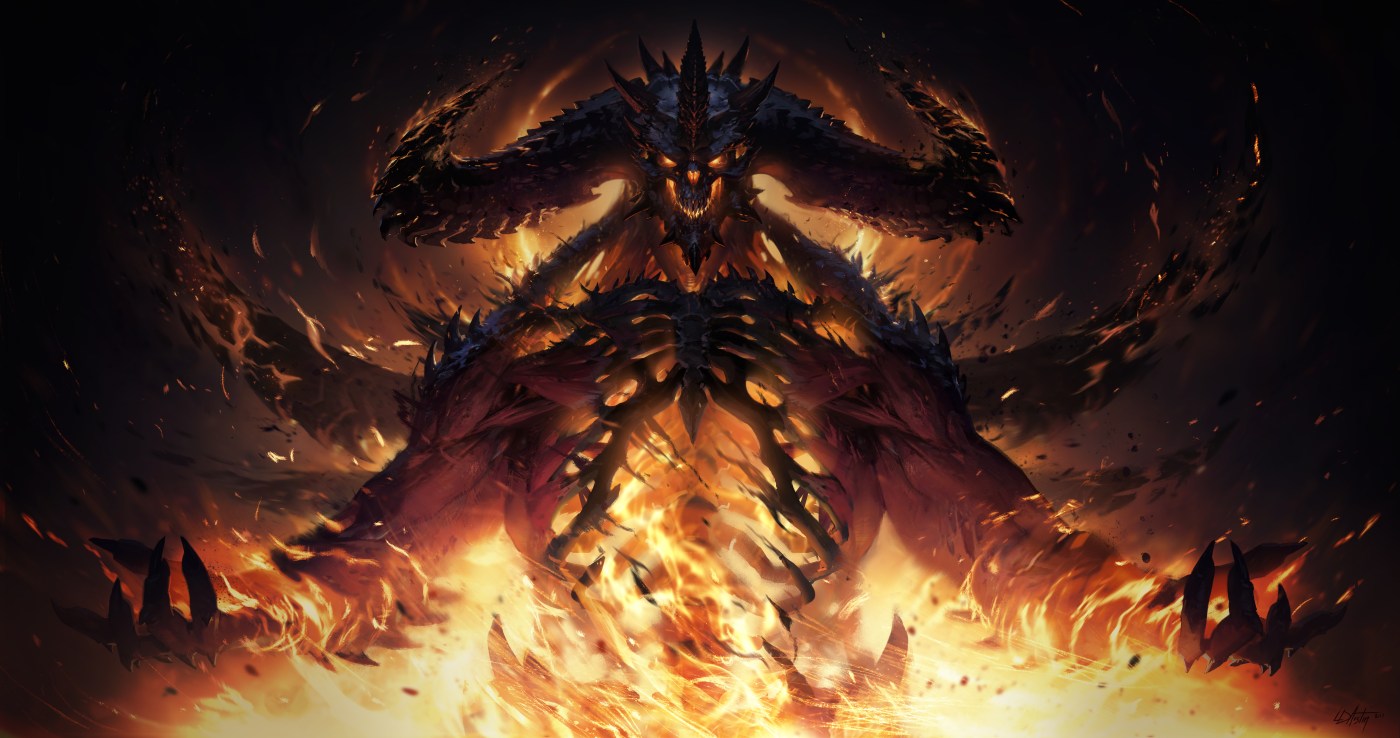
“They love what they love and want what they want”
Blizzard Co-Founder Allen Adham on Diablo fans. [2]
One broken precedent is all that it takes to set fire to this ever socially-regulated industry; One man, the perpetually despised consumer-advocate, to be specific, has stood up firmly and to widespread support defiantly asked but a single question towards Blizzard’s foolish attempt to Q&A the recent Blizzcon announcement of Diablo Immortal; “Is this an out-of-season April Fool’s joke?”
One question to perfectly summarise and clearly represent the fanbase’s reaction to the newly announced mobile addition to Diablo’s sparse but ultimately tightly-refined history.
To say this is Blizzard’s first rodeo with misplaced marketing with Diablo alone would be openly lying, let alone throughout the remaining history of their highly scrutinised IPs. I won’t take you kicking and screaming through those tribulations or the entirety of the Diablo franchise’s ebbs and flows for the sake of brevity and focusing where it actually matters, but I will recap a brief few points, followed by the timeline of the single release that is without a doubt the wick behind the inferno that currently embroils the entirety of any discussion about Immortal.
Diablo (1996) and Diablo 2 (2000) are so beloved it seems disingenuous to merely label them as such; They are revered. Worshipped to the point of proselytism at the sight of any doubt to this day. Developers, gamers and fantasy nerds alike all have their own interests supremely catered to within these two titles.
Diablo put the dungeon-crawling style of rogue-lite on the map (even long before such a categorisation was considered necessary) and lit a fire of inspiration within its peers to match the leaps and bounds. Diablo 2 doubled that down and then some; Huge leaps in design complexity, admiration for build balance and variation of plausible strategy and a story so poignantly grim that even 20 years later the glistening ill will of the Chaos Sanctuary and the daunting stretch that precedes the scaling of the Arreat Summit leaves most of us with a macabre sense of fragility, even with the vast majority of the remaining player base being able to demolish end-game Bosses within seconds, if not sooner.
For the sake of this discussion, all you need to know is that both Diablo and its sequel were UNIVERSALLY adored for absolutely everything they had to offer the medium. After these titans were grounded, the fans were faced with a near 10 year stretch of silence with nary a whisper from the very quickly establishing Blizzard Entertainment.
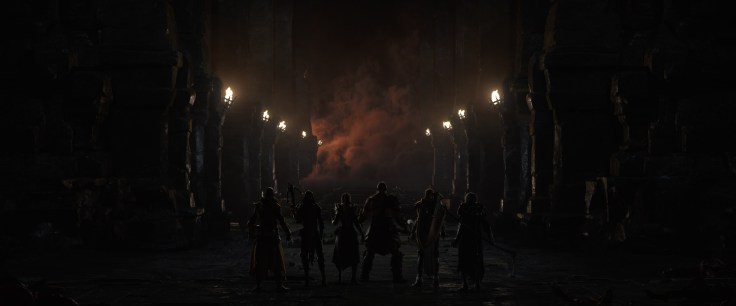
Back when Diablo III dropped on PC worldwide in 2012, 4 years after the silence was broken for an announcement, the torment and utter disappointment of the long-term fans, of which I was one, was the anguish heard around the world. You simply couldn’t avoid discussion of the Real Money Auction House, garbage balance in PvE between classes, zero traditional PvP to speak of or the ever-dreaded Error 37 of launch day fame.
The BattleNet forums were perpetually on fire with feedback, some naïvely polite, while the rest festered as some of the most vitriolic backlash towards a select few people I’ve ever seen. I was part of that vitriol and it remains the reason my account is permabanned from future Diablo discussion.
We attacked viciously and without empathetic thought for a good reason. That vitriol ended up being the buckshot to the back of the head that Blizzard needed to realise where the core problems lied in both design nuance and overall game direction.
The blockage that prevented the pipe of Diablo-tier quality to flow was down to a few decisions that were made VERY close to the top. Those choices were made, whether directly conceptualised or unthinkingly signed off on, by one Jay Wilson, now ex-Director of what I would even cynically struggle not to call a fixed Diablo entry.
Even with the Real Money Auction House expressly ripped out of the game after immense backlash, there was still so much work to be done to bring Diablo III up to expectations. Mechanics were tweaked, skills were entirely reworked; Classes were nerfed and buffed and nerfed again; Levelling and experience was brainstormed to taper out into a long end-game. The item drop system was SO thoroughly thrown on its release state’s head that the new development was outright called ‘Loot 2.0‘
Two years after launch, one after Wilson left the team, the expansion pack Reaper of Souls was released. It added multiple new layers of end-game to occupy yourself with, a satisfyingly climactic Act V and even more ability to personalise so players of all kinds of preferences can enjoy finding the experience-to-challenge sweet spot on the now incredibly vast difficulty scale.
Diablo III had become comfortable as a Diablo game again, rather than whatever heathen spawn of World of Warcraft design documents it had lurched out of the shadows as.
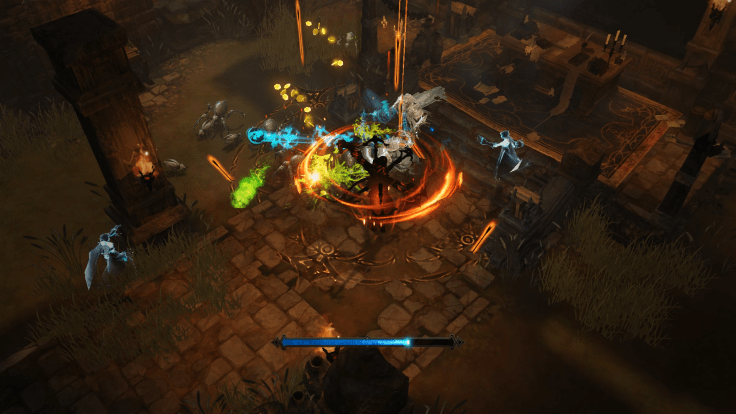
Here we are in 2018, months after Blizzard had shared word of an upcoming Diablo annoucement to the slowly-starving but now stable and even somewhat begrudgingly loyal player base; Whether it was another extension to Diablo III or the grand reveal of its successor, Diablo IV, expectations were high.
The pay-to-attend BlizzCon was always their premier destination for the product drops that would forge financial successes for years to come. Out steps Wyatt Cheng, Principal Game Designer at Blizzard, seemingly unaware of the ill will he was about to spread in all directions across the industry.
A five minute wandering ramble and a reveal trailer later, the crowd was lucidly revolted by Diablo Immortal, a clearly low-budget, exploitative and insidiously produced mobile phone title.
After a solid few years of seeing the Diablo brand repair itself after its own personal identity crisis, consciously deciding in response to the fans that they should do away with excessive simplification and predatory purchasing schemes, it had all just fallen back down the hill into the mud.
This was what had been teased, a brand new game in the Diablo series.
It is terrifying to think that this was passed through so many hands without so much as a single firm catch in the board room; The executive wing of Blizzard had once again grabbed the reins of emerging game design.

While interesting to ponder, I have few doubts that Cheng et al didn’t see this backlash coming.
A foreboding post put up on the official Diablo website a few weeks ago squeaked out signs of weak confidence and looming anxiety, stating “While we won’t be ready to announce all of our projects, we do intend to share some Diablo-related news with you at the show.” There was clearly a sense of dread in the Blizzard offices. They chould sense a wave of bad PR coming their way.
To follow such a knowingly unpopular announcement with a fan Q&A session might be a testament to how much Blizzard internally do care for the consumers and want to immediately know feedback, but the bear trap they were throwing themselves into was practically spitting flames in the distance as they approached it.
“Is this an out-of-season April Fool’s joke?” asked one fan, in the most honest and cheeky communication any department could have hoped for. What they definitely didn’t hope for is what happened afterwards.
The entire auditorium busted into laughter and applause; More applause than the reveal itself received and more laughter than any talking head had been responded to with so far.
From this point the showrunners meekly damage control their way to a bitter and unnoteworthy fizzle, as you would expect anyone in such a position to do, possibly in a less professional manner too.
Kudos to the representatives for staying well composed at the exact moment their employer saw the match coming towards the oil-slick and bolted; While people have been poking fun at the completely understandable bewilderement and unsuredness of the follow-up, I see nothing but a wavering poker face on professionals.
Professionals that were reading the room accurately.
“It’s not good for a game like Diablo. It doesn’t feel good to get items for money: It feels good to get items by killing monsters”
Jay Wilson, ex-Director of Diablo III, upon removing the Real Money Auction House after massive fan backlash [1]
Along to be torched to death by the wrath of roughly 10 million fans is NetEase, a China-based company that handles the role of licensee for Blizzard’s releases in the Chinese region. In terms of publishing and development credentials, they are known for some of China’s largest online titles such as Fantasy Westward Journey, previously seen with around 350 million registered users.
The remainder of their work can only be politely referred to as fluffy trend-chasing mobile games. Of irrelevant interest, they were one of a few targets that nearly got hammered to death by this years copyright tantrum by PUBG, which they thankfully survived.
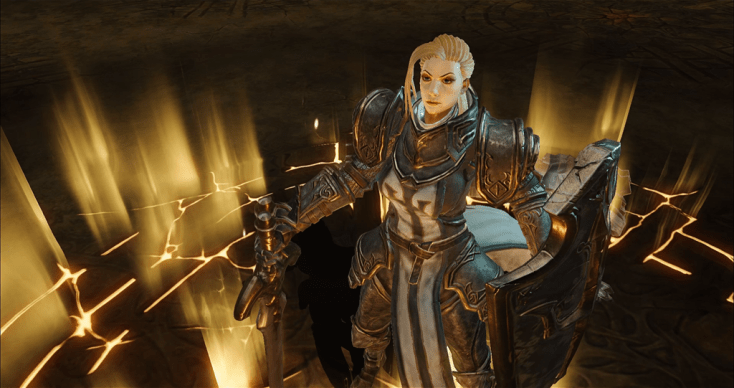
To say that the game looks cheap may seem a stretch considering the abysmal standards present on any mobile platform, but to see such a wonderful aesthetic as the one crafted for Diablo III crushed beyond recognition is a massive disappointment.
Of the few people who actually tried Immortal out at BlizzCon, all impressions came out noting mechanical simplicity. It is expected, simplicity in a mobile conversion; Diablo is now quite obviously not seen as something that can pull moves like that.
You see, most of the issues beyond broken economies and shady trading practices upon release of Diablo III were centered around the need to tighten a potential scale. It is a scale that is mended for all to use as they see fit in its modern form; The difficulty scale.
Casualisation is the word that most commenters are using online, as they did when Diablo III crashed out, instead of the marketer’s preferred nomenclature of ‘accessibility’. The two have a distinct difference beyond being weaponised as oppositional rhetoric.
Streamlining a game can be all well-and-good, even beneficial to the coherence of any play that isn’t at the expert level, but once you crank that ceiling of variance down to meet the ground, you lose not only that which made Diablo the unique beast that it was before a few full generations of dead-obvious Diablo-clones eventually eked out a victory or two over the Diablo structure in place in its strongest form, modern-day Diablo II, but also the actual accessibility becomes neutered too. Above a particular frantic tier of desire for gameplay complexity, you lose the market entirely.
That market is almost the entirety of existing explicit Diablo fans.
The release grievances thrust upon Blizzard in 2012 weren’t all disappointment and vitriol; There was genuine concern about the company’s conceptual future after years of incredibly well-praised reputation came slamming to a halt. With Wilson’s departure, Loot 2.0 and the entirety of Reaper of Souls, layers were placed back onto the structure, giving way to taller and taller possibilities for experiences by all from the most timid of casual gamers to the stat-cruncher doing the mad race-to-the-finish antics of the frequently reset Seasonal character modes.
Now we see a few of those layers of alleged learning fall back to reveal what could be not only an overly simple Diablo experience, but one packed to the gums with microtransactions, pay-to-win or even “time-savers”, as Ubisoft affectionately calls wasting time by design as a means to encourage extra purchases. Ultimately what Immortal holds in regards to that is still up in the air, though there is little doubt a mobile-exclusive title by a AAA company would even exist without such practices in place.
All that was learned and apparently lied about back in 2012 and 2013 was just another step in a series of conniving schemes to maintain a perpetual flow of what was sometimes critique, sometimes hatred. Back to the mines to extract money out of the fans, except this time we’ve brought the legitimate problem gamblers of the gaming industry, mobile gamers, along for the ride with the starved loyalists!
Amongst the myriad of concerns were relatively legitimate ones about the game being a reskinned version of a previous NetEase title, most prominently Crusaders of Light, noticeable for its rather familiar UI and aesthetic.
Out came an almost immediate reassurance that Diablo Immortal was an entirely home-made product from the mouth of the Co-Founder of Blizzard, Allen Adham, when speaking to Kotaku; It was additionally stated that the UI choice is something of a trend for the Asian market at this moment.
“I want to assure you that Diablo Immortal is purpose-built from the ground up”
Blizzard Co-Founder Allen Adham on concerns that Diablo Immortal could be a reskinned title [2]

What we are all left with after this depressing experience may end up just being a momentary bad taste in our mouths. We know little about the title beyond what the Blizzard Press Center can show you and we are immediately responded to in our concerns about low-effort reskinning; It remains to be seen whether that holds as true.
Amongst the fray of heated discussion are narratives of entitlement in gamers.
It is a tale you’d have no issue conceptualising being spun at this point. It is also one the gaming community have all but gained immunity from, let alone the Diablo fans, who have already copped this type of heat for nearly identical backlash, the one that saved Diablo III.
For that purpose, I won’t even dignify those with a response nor will I push conspiracy as to why you’d defend such a blatantly terrible move for Diablo.
Blizzard knew this was going to end poorly. There is zero chance that no one on the board had witnessed the great BattleNet forum war of 2012 and decided with a clear conscience that such an idea was a fantastic profit venture that had been placed back on the table. That cast was sent to be sacrificed for a reason that I cannot fathom, even without considering the immensely absurd choice of a subsequent Q&A to rub salt in their own wounds.
Diablo III grew to become a game that many of even the most poisonous Diablo II loyalists will grant a nod to upon passing. Part of the respect the community holds for it is the gradual enlightenment of the team to the fanbases true expectations for such a heavily branded installment, not just the end-state of a thoroughly enjoyable and mechanically and skillfuly diverse action RPG.
Kneejerk petitions from the angrier end of the fan gradient to cancel the title or otherwise tinker with the elephant in the room won’t fix what might occur from here.
All that can be done is a dusted-off hope that Blizzard at least listens to the constructive feedback; They’ve previously been directly instructed on how to save themselves from embarassment from the fans, by the fans. There is no reason why even a commonly-disliked entry to a franchise has to suffer on its own, especially when such a passionate community is on-call.
Passion is a term I’ll leave you with. We all do this to Diablo as both a passionate drive to punish the series into refinement as well as a motherly concern about the wellbeing of a landmark series in video game history.
I’m not the only one leaving you with “Passion” though; Here it is out of the mouth of a clearly disappointed but understanding Adham. Further proof that Diablo Immortal is a product born of miscommunication.
Miscommunication and greed.
“That passion, it’s actually what drives us, and we feel it too. It’s why we make games and why we’ve made games for almost three decades now — and why our community is so passionate about our franchises. I understand their feeling and wish we could share more about all the amazing things we’re doing, not just with the Diablo franchise but across the company as a whole.”
Blizzard Co-Founder Allen Adham’s perception on the immediate backlash to Diablo Immortal. [2]
Sources
[1] Jay Wilson on Real Money Auction House
https://venturebeat.com/2014/03/19/meet-the-gamers-who-earned-big-in-the-now-closed-diablo-iii-real-money-auction-house/2/
[2] Blizzard Co-Founder Allen Adham speaking to Kotaku
https://www.kotaku.com.au/2018/11/blizzard-says-it-wasnt-expecting-fans-to-be-this-angry-about-diablo-immortal/
“Diablo at BlizzCon 2018” from Blizzard [posted 17th October]
https://us.diablo3.com/en/blog/22549433
 Glitching Is Art
Leave a comment